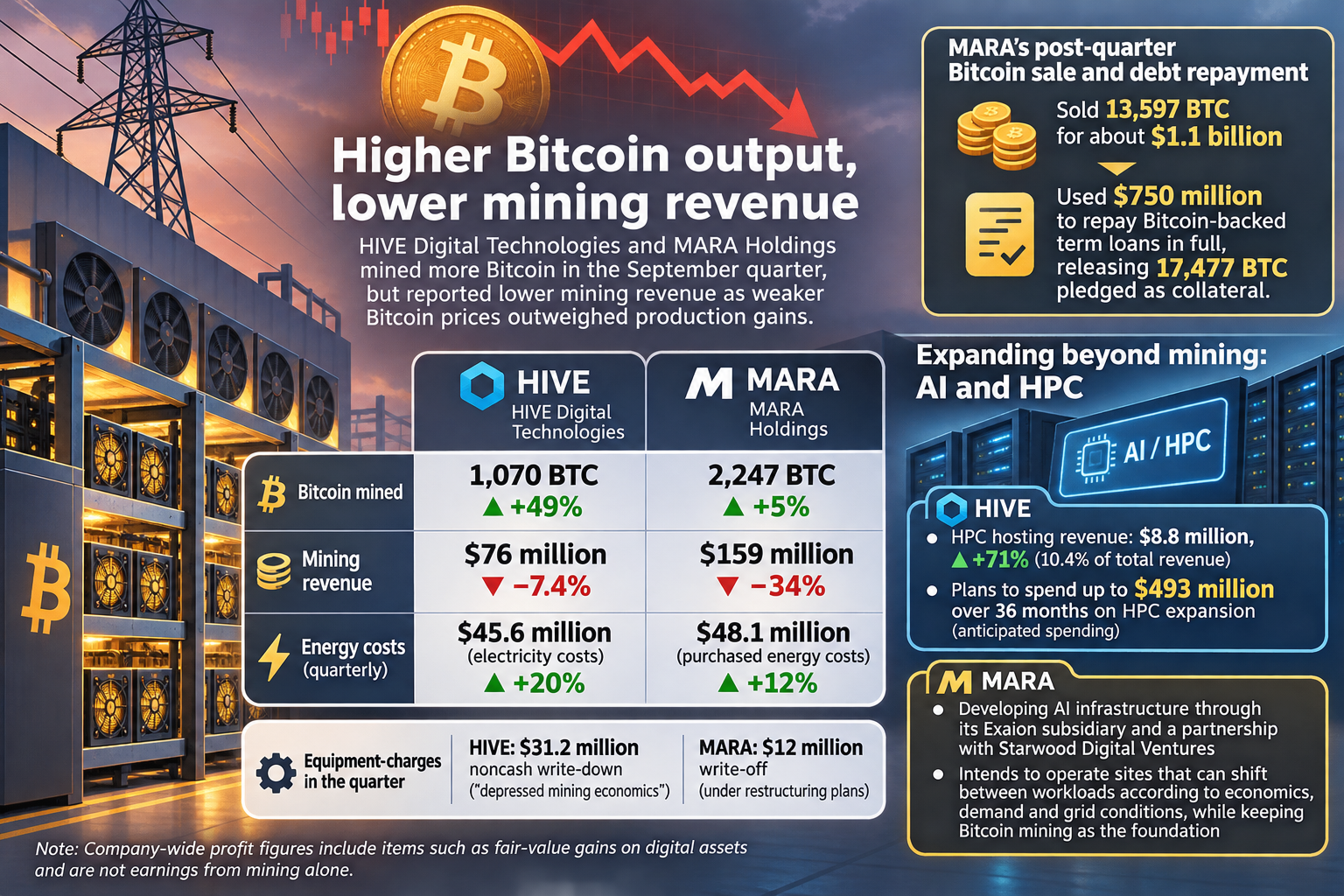
What happens to a miner’s operating results when Bitcoin output rises but the price it receives weakens? In their September-quarter results, HIVE Digital Technologies and MARA Holdings both reported higher production than a year earlier and lower Bitcoin mining revenue. Their filings also showed higher energy costs and equipment write-downs.
| Company | Bitcoin mined | Mining revenue | Energy costs |
|---|---|---|---|
| HIVE | 1,070 BTC, up 49% | $76 million, down 7.4% | Electricity costs of $45.6 million, up 20% |
| MARA | 2,247 BTC, up 5% | $159 million, down 34% | Purchased energy costs of $48.1 million, up 12% |
The reported revenue declines came despite the production gains, as weaker Bitcoin prices outweighed the additional output. MARA’s energy costs rose as it expanded its owned mining operations. HIVE recorded a $31.2 million noncash write-down on mining equipment, citing “depressed mining economics.” MARA separately wrote off $12 million involving mining rigs and equipment under restructuring plans. These company-level figures do not establish the profitability of an individual mining machine or site.

Mining, debt and other workloads
After the quarter ended Sept. 30, MARA sold 13,597 BTC for about $1.1 billion. It used $750 million of the proceeds to repay its Bitcoin-backed term loans in full, releasing 17,477 BTC pledged as collateral.
Both companies are continuing to invest in mining while developing artificial-intelligence and high-performance-computing (HPC) businesses. HIVE’s HPC hosting revenue rose 71% to $8.8 million in the quarter, or 10.4% of total revenue. HIVE said it anticipates spending up to $493 million over 36 months on HPC expansion, including land, data-center infrastructure and GPUs; it had spent $145.3 million toward that expansion as of its filing. It also plans to spend about $35 million converting its Toronto facility into a Tier-III data center and is targeting a 100-megawatt substation expansion at its Yguazú mining site in Paraguay during 2026.
MARA is developing AI infrastructure through its Exaion subsidiary and a partnership with Starwood Digital Ventures. The company said it intends to operate sites that can shift between workloads according to economics, demand and grid conditions, while keeping Bitcoin mining as the foundation of its platform. Elsewhere in the sector, American Bitcoin reported weaker mining margins despite a treasury-driven quarterly profit, while Core Scientific said it planned to leave mining entirely by year-end.
Company-wide results are not mining revenue
HIVE reported fiscal second-quarter revenue of $84.9 million, down 2.7% year over year but above the $79.4 million consensus estimate listed by MarketBeat. According to Google Finance, its Nasdaq-listed shares closed Monday’s regular session up 1.7% at $1.81, then fell 1.7% to $1.78 in after-hours trading.
MARA reported quarterly revenue of $164.2 million, down 35% year over year. Net income attributable to common stockholders rose to $634.4 million from $123.1 million a year earlier and included substantial fair-value gains on digital assets and digital asset receivables. Diluted earnings rose to $1.28 a share from 27 cents. Its shares closed Monday up 4.6% and were little changed at $6.64 after hours. Those company-wide profit figures should not be read as earnings from mining alone.
Source: cointelegraph.com (originally published 2026-11-10 08:42 UTC+8)