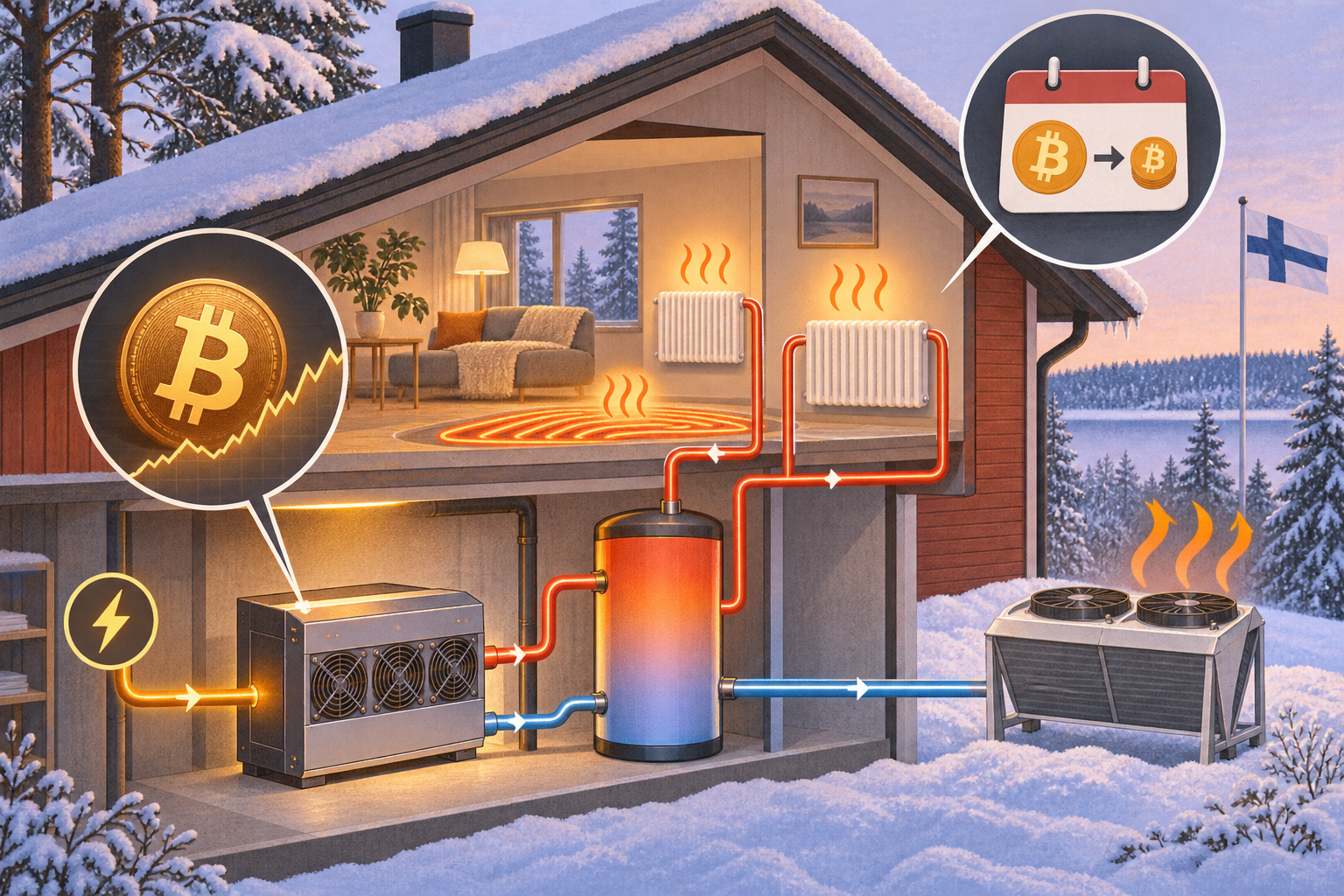
Can a Bitcoin miner pay for the electricity it uses to heat a home? That is the operating question behind SunBit’s “Bitcoin boiler.” As reported on November 9, 2026, one 180-square-meter home in Nokia, Finland, had disconnected from district heating and was relying entirely on the system. Whether that arrangement saves money depends on mining revenue—not on the miner producing heat more efficiently than a conventional electric heater.
SunBit CEO Elmeri Suomi told CoinDesk that the company had delivered its first production units in 2025 and had 30 systems operating. All but one were in Finland. The overseas installation, in Leekum, the Netherlands, replaced gas heating in 2025. Other reported uses included a 200-square-meter Finnish home combining a miner with an oil boiler, a manor heating a 1,500-liter water tank, and a 3,000-square-meter industrial building with an air-source heat pump and surplus power from a 30 kW solar array.
What the operating model assumes
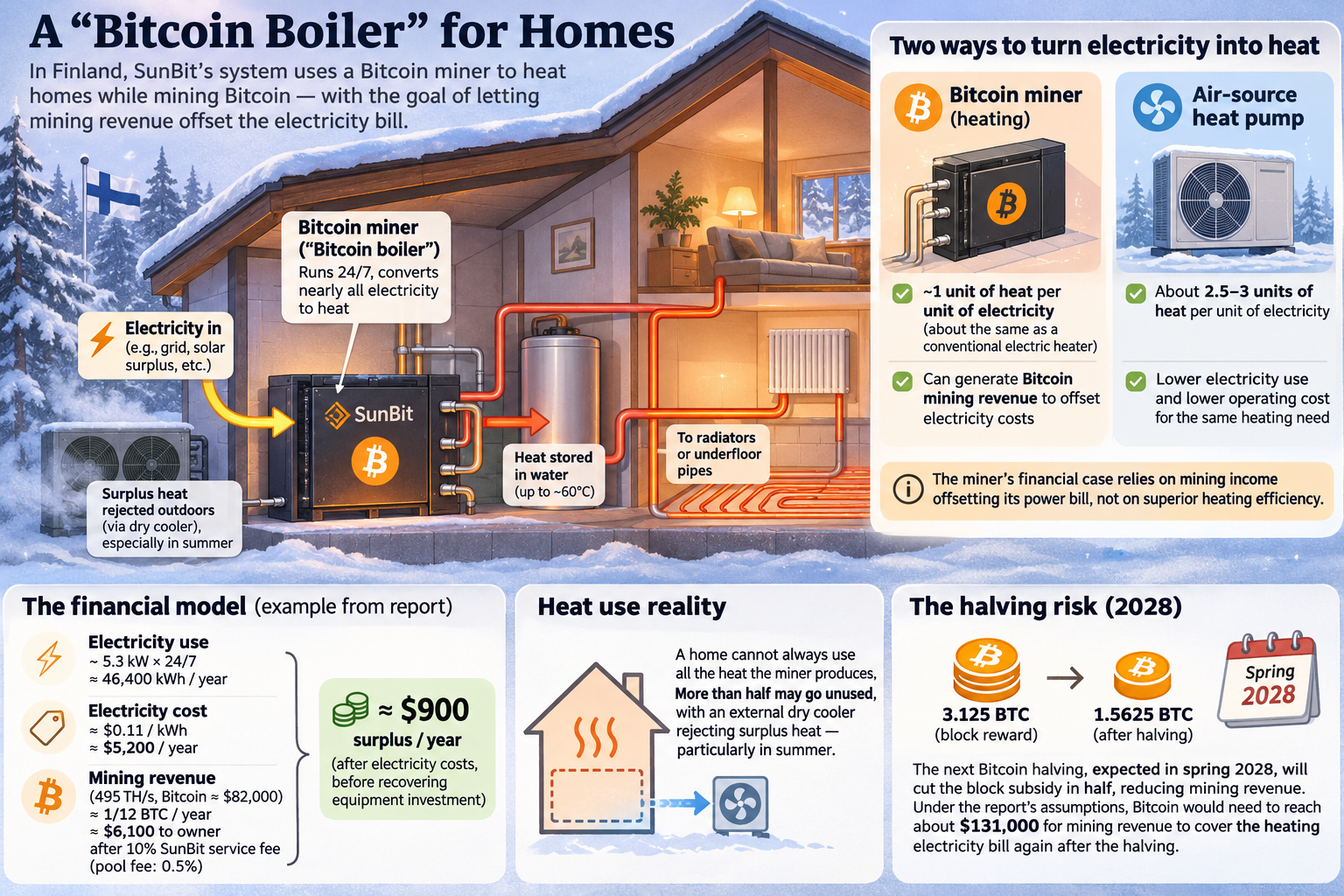
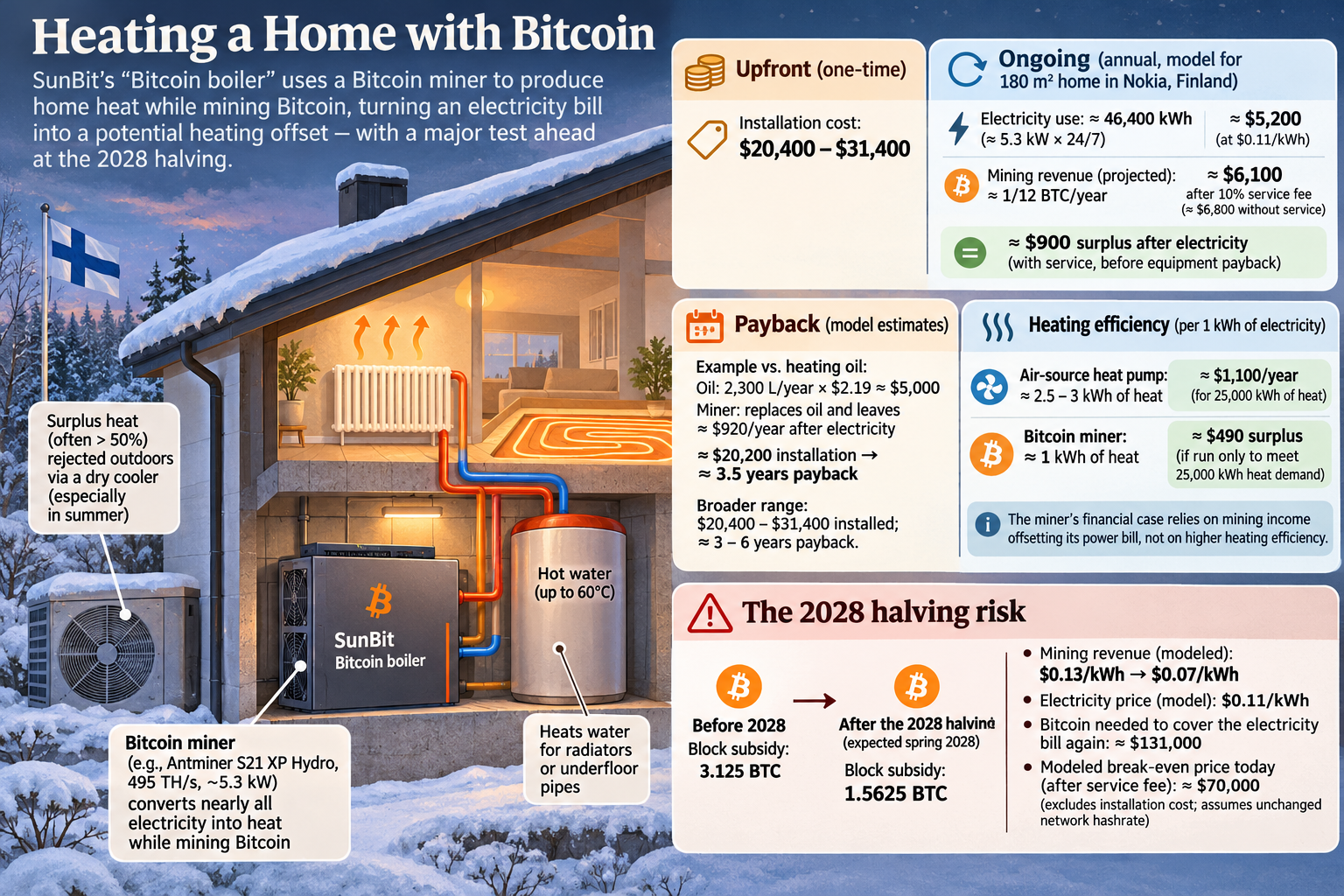
SunBit’s model for the Nokia home uses an Antminer S21 XP Hydro rated at 495 TH/s, running Braiins OS. At roughly 5.3 kW around the clock, it would consume about 46,400 kWh a year. At $0.11 per kWh, SunBit puts annual electricity spending at approximately $5,200.
The revenue side is a projection. Assuming Bitcoin at $82,000 and network hashrate at 1,040 EH/s, SunBit estimates the machine would mine about one-twelfth of a bitcoin annually. After its optional 10% service fee, the owner would receive Bitcoin worth about $6,100; a mining pool would also charge a 0.5% fee. Without the SunBit service, the modeled gross value is about $6,800. Under the paid-service scenario, the company estimates roughly $900 left after electricity costs, before recovering the equipment investment. The optional service includes remote monitoring, optimization for Finland’s variable electricity prices and an app.
Suomi also provided a pool-account screenshot for an earlier customer using a different, 358 TH/s S21+ Hydro. It showed 0.039 BTC mined over the preceding year, worth about $3,160 at the price then used. SunBit said it could view data from its first pilot customers but not later customers’ private pool accounts. That observation should not be confused with the projected output of the 495 TH/s machine.
Heat use and capital costs
A miner converts nearly all the electricity it consumes into heat, which SunBit stores in water for distribution through radiators or underfloor pipes. But a home cannot necessarily use that heat whenever the machine produces it. According to the report, more than half the output may go unused, with an external dry cooler rejecting surplus heat—particularly in summer.
SunBit compared its system with a detached home using 2,300 liters of heating oil annually at about $2.19 per liter, or roughly $5,000. Its model projects that replacing the oil expense and retaining about $920 after mining electricity costs could repay an approximately $20,200 installation in around three and a half years. That estimate excludes maintenance, financing costs and optional additions. The report also gives a broader installed-price range of $20,400–$31,400 and projected payback periods of three to six years.
An air-source heat pump poses a different comparison: the report estimates 2.5–3 units of heat per unit of electricity for a heat pump, against roughly one unit of heat per unit of electricity consumed by a miner. For a home needing 25,000 kWh of heat a year, SunBit estimates about $1,100 in annual heat-pump operating costs or $3,170 for district heating. It projects a $490 surplus after electricity costs if the miner runs only long enough to meet that heating demand. The miner’s financial case rests on mining income offsetting its power bill, not on superior heating efficiency.
The halving risk
At the roughly $81,500 Bitcoin price cited when the original report appeared, SunBit put its operating break-even price near $70,000 after its service fee. That threshold excludes the purchase and installation cost and assumes unchanged network hashrate.
The next Bitcoin halving was expected in spring 2028, before many new customers would recover their upfront costs. The block subsidy would fall from 3.125 BTC to 1.5625 BTC. SunBit’s payback calculator did not incorporate the halving, and the company did not promise a fixed return. Holding the model’s other assumptions constant, the report estimates mining revenue would fall from $0.13 to $0.07 per kWh against an $0.11 per kWh electricity price. On those assumptions, Bitcoin would need to reach about $131,000 for mining revenue to cover the heating electricity bill again. Actual results will depend on Bitcoin’s price, network competition, electricity costs and how much of the heat a property can use.