As reported on November 19, 2026, Bitcoin had fallen back toward $62,000 for the second time in less than a week. The immediate question for the market was not a change in Bitcoin’s mining economics, but how much further the Federal Reserve might raise interest rates—and whether buyers would return at that price.
Ether fell below $1,750, touching $1,735. The weakness extended beyond crypto: over the preceding 24 hours, spot gold fell 3.6% and silver roughly 5%, while London copper dropped more than 4% intraday and London tin more than 8% at one point.
December and January remain open questions
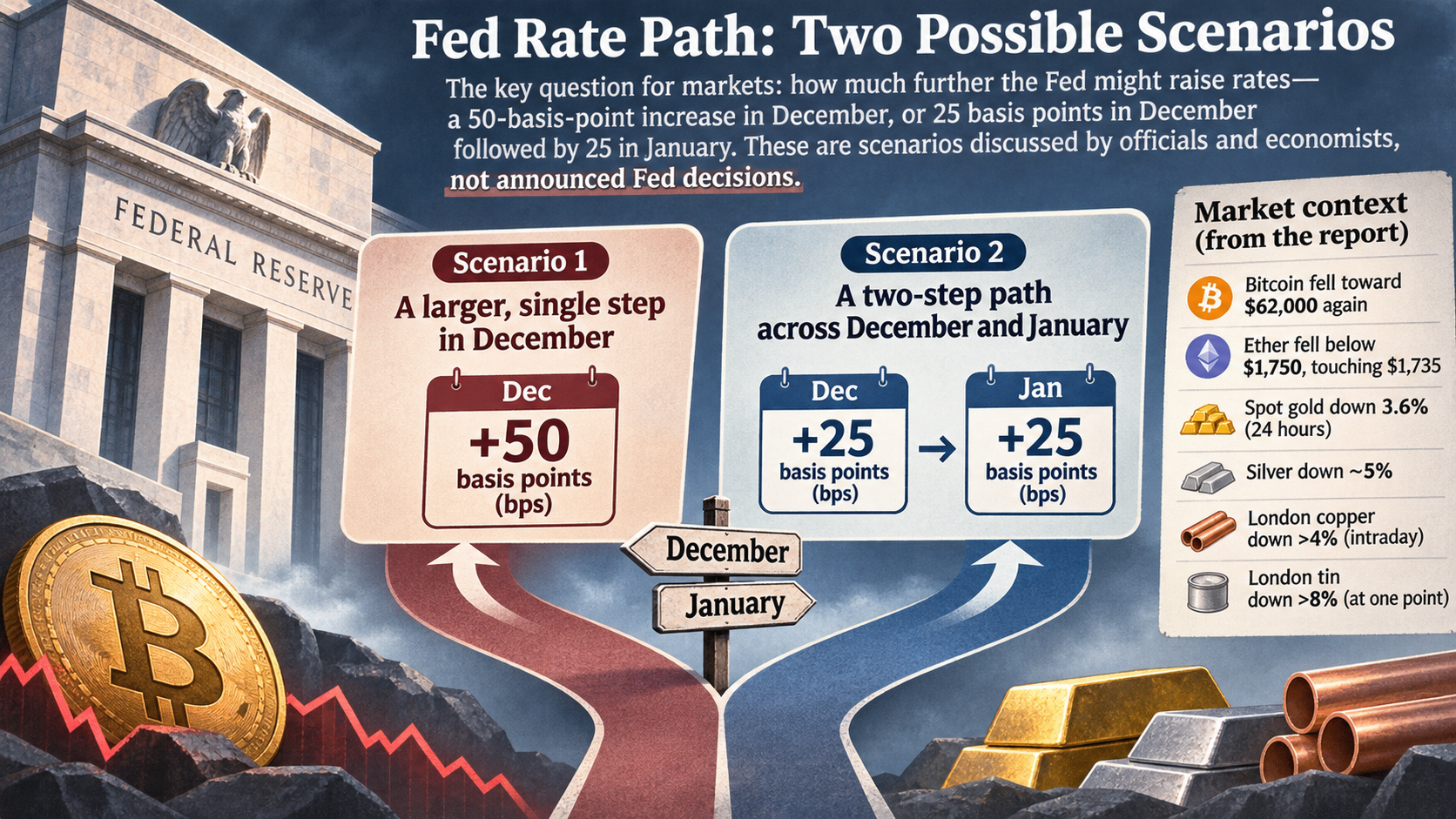
Fed governor and Federal Open Market Committee voter Christopher Waller told CNBC that US inflation was moving in the wrong direction, with price pressure spreading to services. He favored a 50-basis-point increase in December, though he said a 25-basis-point move could work if the Fed clearly signaled another 25 basis points in January. These were Waller’s preferences, not announced Fed decisions.
Minutes of the October Fed meeting, released on the morning of November 19, showed disagreement over the pace of increases. After a 25-basis-point rise in September, the Fed held its rate range at 3.75%–4.00% in October. Governors and regional Fed officials discussed further increases; two said a December move of more than 25 basis points could be considered if subsequent inflation data disappointed. San Francisco Fed president Mary Daly favored smaller steps, while Fed governor Michael Barr said another increase would be appropriate if the economy developed as expected.
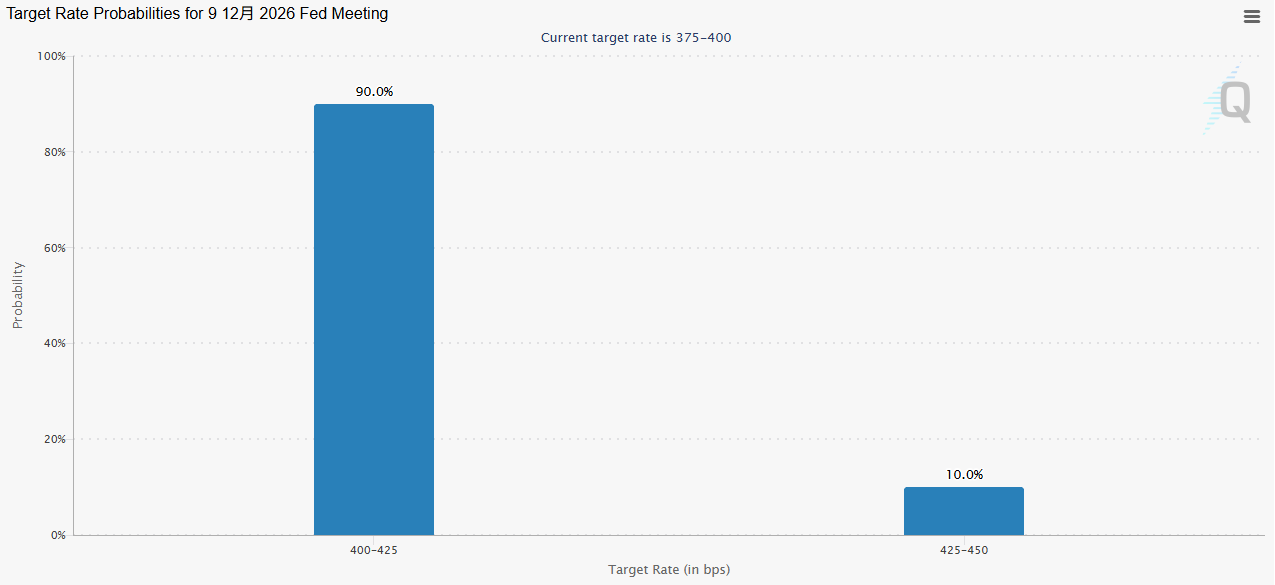
At the time of reporting, CME data put the probability of a 25-basis-point December increase at 90%, versus 10% for 50 basis points. The probability of cumulative increases of 50 basis points by January was 75.5%. Those figures describe market pricing, not a policy commitment. BMO Capital Markets economist Scott Anderson said the October minutes reinforced expectations of increases at both meetings; LPL Financial economist Jeffrey Roach expected improving inflation readings and considered 25 basis points in December sufficient.
The distinction between falling energy prices and persistent core inflation remained important. Economist Robin Brooks noted that lower oil prices had reduced inflation expectations implied by the Treasury market. Fed officials, meanwhile, had identified elevated price growth in core services excluding housing and demand for AI infrastructure pushing up some technology-product prices.
Bitcoin buyers remain cautious
Bitwise chief investment officer Matt Hougan wrote on November 17 that stronger-than-expected US inflation had increased the likelihood of a December hike, while roughly $2 billion in leveraged positions were liquidated during a thinly traded weekend, amplifying Bitcoin’s earlier decline toward $62,000. The DeFi Report founder Michael Nadeau said he added to his position in that sell-off, betting on a short-term rebound. K33 research head Vetle Lunde pointed to more than half of circulating coins being at a loss, negative perpetual-futures funding rates and elevated options-hedging demand as signs of market stress.
After the Fed minutes, attention shifted toward the possibility of a strong dollar and high Treasury yields persisting. Sygnum Bank chief investment officer Fabian Dori said Bitcoin’s ability to withstand that pressure would depend on institutional allocation and demand for protection against currency depreciation. Bitget analyst Lewis Huang warned that, after Bitcoin fell below its roughly $68,000 200-week moving average, a further rise in the dollar and yields combined with a break below $62,000 could prolong selling.
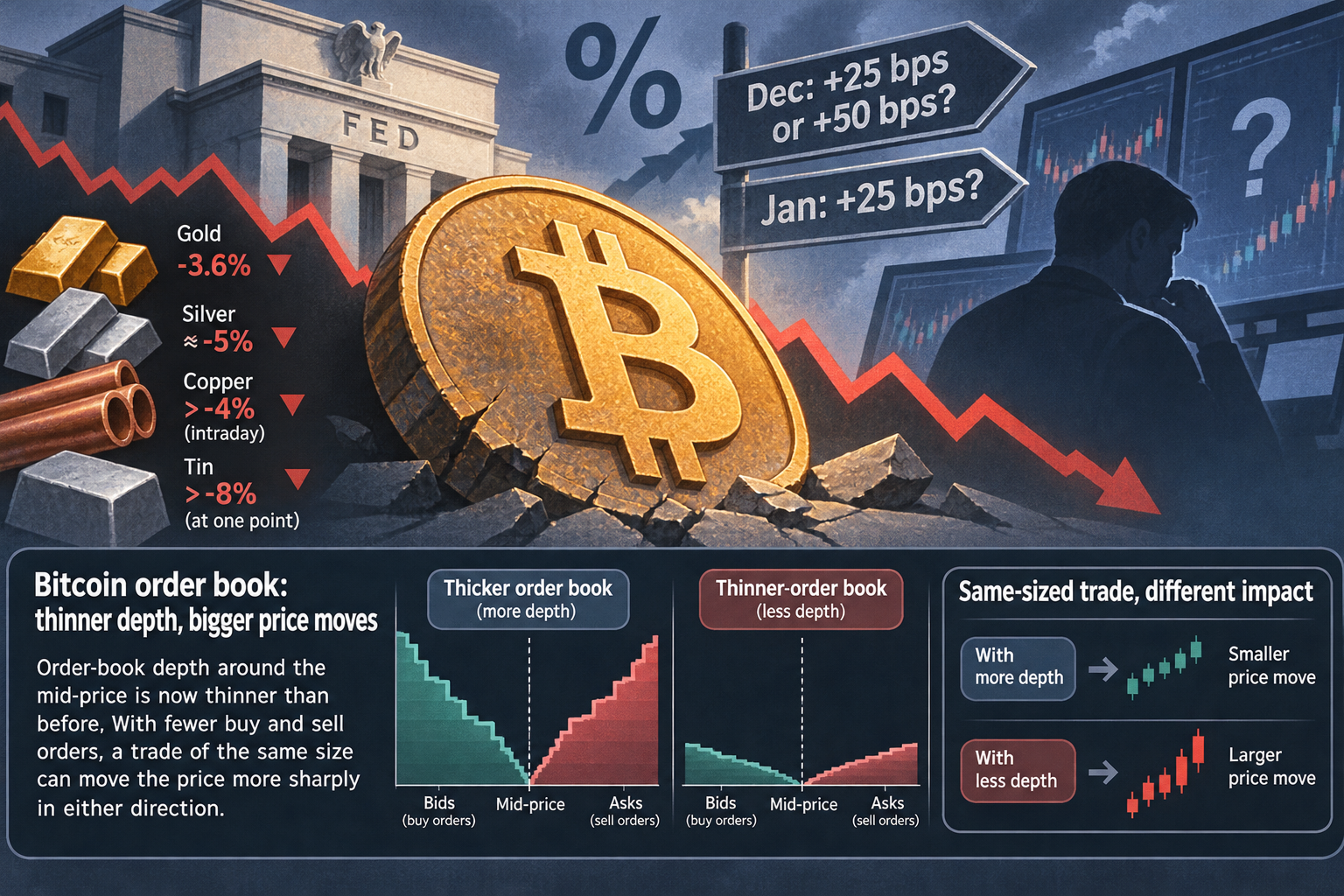
There was little clear evidence of renewed spot buying in the report. Wintermute over-the-counter trader Jasper de Maere questioned whether the rise from July’s low had been a false breakout, citing weak demand from ETFs, crypto treasury companies, retail investors and institutions. Talos data showed that total orders within 1% of Bitcoin’s mid-price were nearly 38% below their yearly high before the Binance theft cited in the report. A thinner order book can make a given trade move the price more sharply in either direction.
Views on a potential bottom diverged. Fidelity’s Jurrien Timmer said Bitcoin was near support in his long-term price model, while acknowledging that a decisive break would test the model. Wellington-Altus strategist James Thorne saw a bullish weekly-chart pattern that he said would be invalidated at $57,000. Veteran trader Peter Brandt instead warned of a possible head-and-shoulders top, with greater downside risk if the pattern were confirmed.