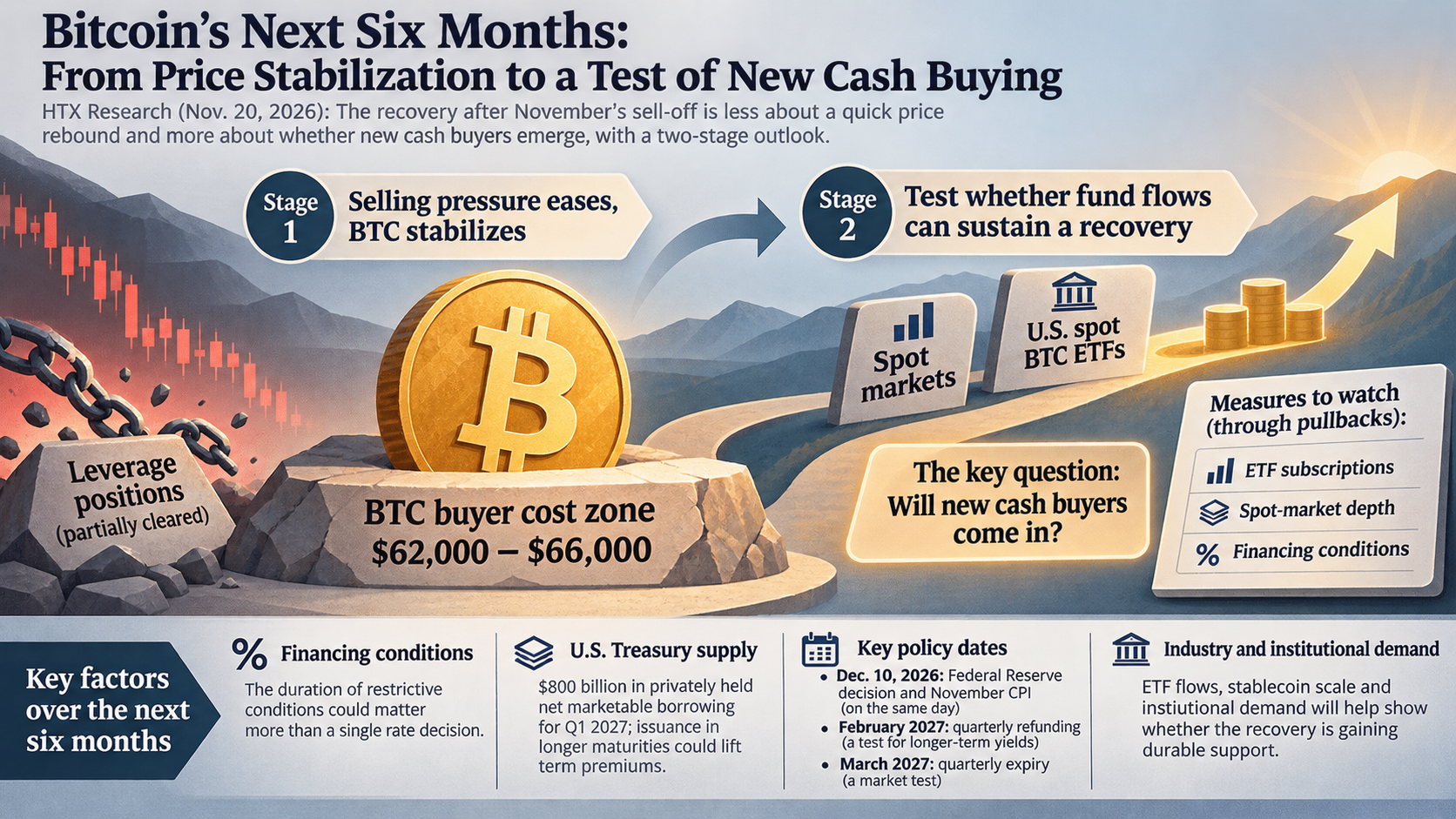
As reported on November 20, 2026, HTX Research argued that Bitcoin’s recovery after November’s sell-off would depend less on a quick price rebound than on whether new cash buyers emerged. Its six-month outlook envisaged two possible stages: selling pressure easing enough for BTC to stabilize, followed by a test of whether fund flows could sustain a recovery. That was a forecast, not evidence that buyers had already returned.
Price recovered faster than participation
According to the report, total crypto market capitalization rose 39.6% quarter over quarter in the third quarter, while spot trading did not increase at the same pace. Citing Farside data, HTX Research said U.S. spot Bitcoin ETFs recorded $2.579 billion in cumulative net outflows from November 2 through November 17. DeFiLlama data showed stablecoin market capitalization down 5.33% over the preceding 30 days as of November 18.
The report placed BTC in a $62,000–$66,000 range it described as a recent buyer cost zone. It judged that some leveraged positions had been cleared, but that new cash buyers had yet to appear.
Financing conditions and institutional demand
HTX Research said the duration of restrictive financial conditions could matter more over the following six months than the direction of any single interest-rate decision. It pointed to the U.S. Treasury’s estimate of $800 billion in privately held net marketable borrowing for the first quarter of 2027. If more issuance came in longer maturities, the report said, higher term premiums could push up long-term yields; it identified February’s quarterly refunding as a test of that possibility.
The report also flagged December 10, 2026, when a Federal Reserve decision and November CPI data were due on the same day. A rebound after those events might initially reflect repositioning, it cautioned, rather than sustained new investment. It identified ETF subscriptions, spot-market depth and financing conditions as measures to watch through subsequent pullbacks, including the March 2027 quarterly expiry.
For scale, HTX Research compared roughly $240 million in ETF net outflows on November 17 with the nominal value of Bitcoin’s daily newly issued block subsidy, calling the outflow about eight times larger. That is a comparison of market-wide flows and issuance—not a measure of any individual miner’s revenue or costs.
The report’s conclusion remained conditional: spot net buying and improved financing could support a more durable expansion, while a recovery driven mainly by short covering and renewed leverage could leave BTC repeatedly testing the same cost zone.