Can a GPU earn revenue from a customer’s AI inference request while also mining a proof-of-work coin? That is the operating question behind Pearl. In an assessment published on November 19, 2026, crypto investment firm Syncracy argued that the answer could reshape mining economics—but its case depends on a planned upgrade and adoption by inference providers. Syncracy disclosed that it had built a substantial PEARL position over the preceding two quarters.
One workload, two revenue streams
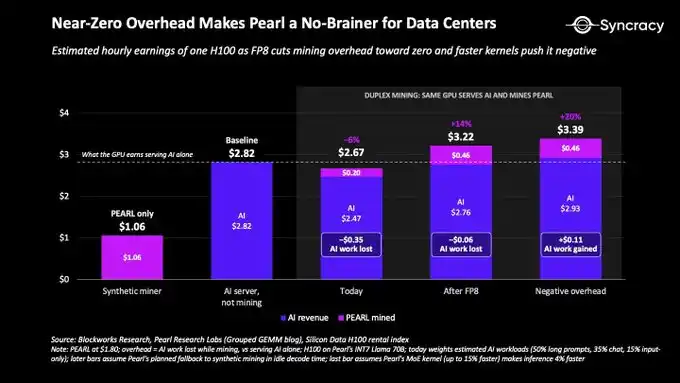
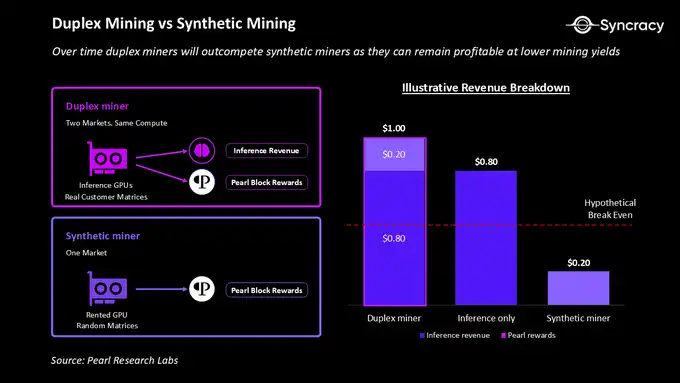
Pearl aims to turn matrix multiplication used in AI inference into work that also helps secure its network. An inference provider could then collect payment for the customer task and earn PEARL from the same GPU workload. That differs from a dedicated miner performing calculations solely to earn block rewards: if inference revenue already covers operating costs, the provider may keep running even when mining revenue alone would not support a dedicated miner.
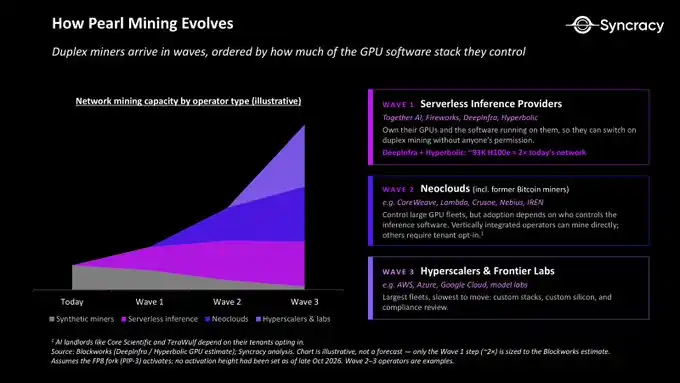
Syncracy pointed to Together AI’s inference service, which it said processes customer requests while mining PEARL and uses the tokens to subsidize inference prices. That is a commercial example of the proposed model, not evidence that it has been adopted across AI data centers.
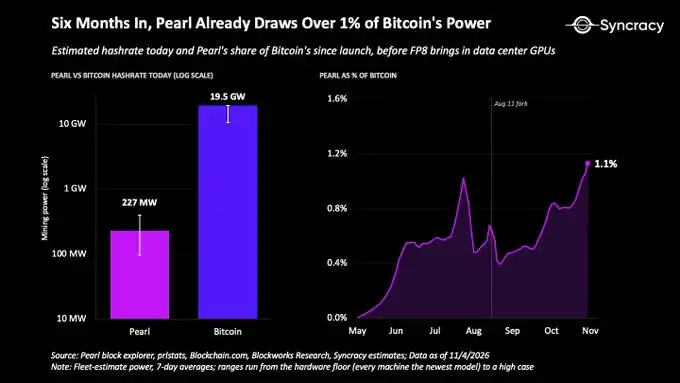
The immediate constraint is technical. Pearl mining used integer matrix multiplication at the time of Syncracy’s report, while modern inference increasingly used lower-precision formats such as FP8. Syncracy said its discussions with miners indicated that roughly 80% of Pearl mining was still performed on consumer GPUs, mostly in China. It projected that a planned FP8 upgrade could reduce mining’s approximately 5% additional overhead to near zero. Whether it does so in production—and whether inference operators then connect meaningful customer-paid workloads—remained unproven.
Why power allocation matters to Bitcoin miners
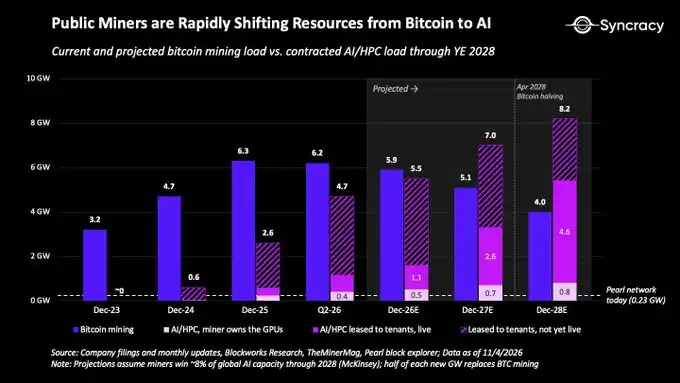
Syncracy framed Pearl’s opportunity against Bitcoin miners’ competing use for power and data-center capacity. It cited data indicating that, across 2026–2028, as much as 44% of public miners’ power capacity, measured in megawatts, had been contracted for AI and high-performance computing. Those contracts concern capacity, not a measured decline of 44% in Bitcoin’s network hashrate.
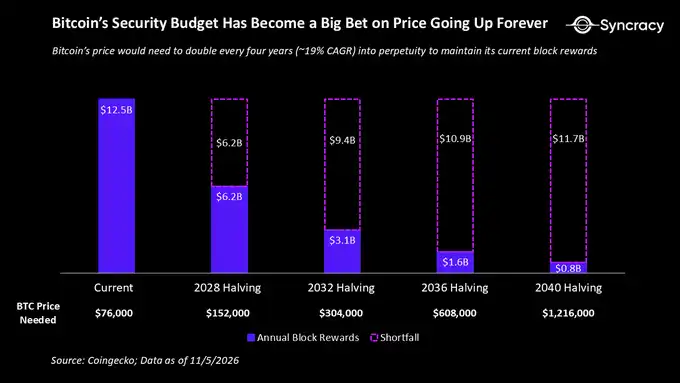
Bitcoin’s block subsidy halves roughly every four years. Syncracy calculated that, if transaction fees do not make up the difference, Bitcoin’s price would need to double every four years—about 19% annual compound growth—to keep the subsidy’s dollar value unchanged. That is a conditional calculation, not a forecast of Bitcoin’s price or an observed mining-cost figure. Syncracy argued that longer-term AI contracts with potentially higher, more predictable margins could draw infrastructure away from Bitcoin mining.
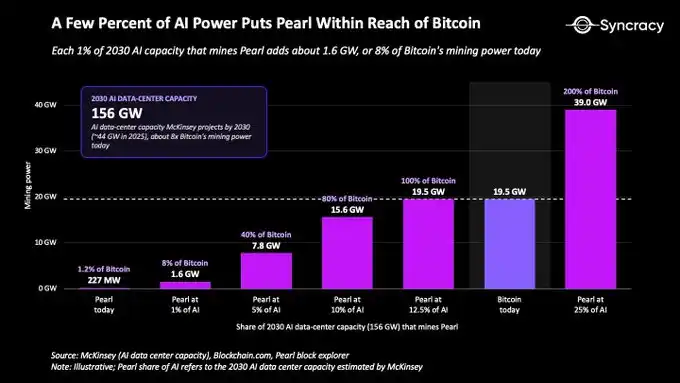
More computation is not automatically more security
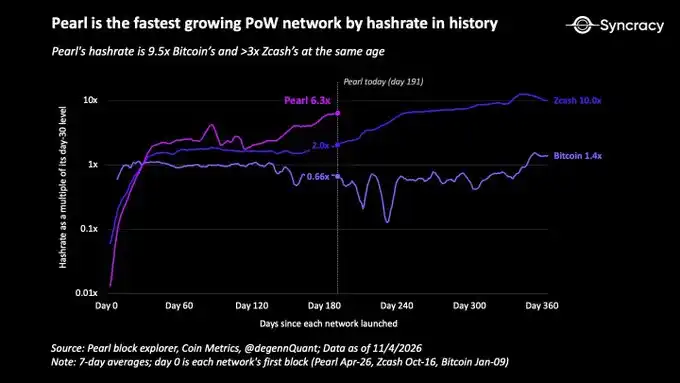
Syncracy suggested that Pearl could attract more computing and energy resources than Bitcoin before 2030. It acknowledged that the networks perform different calculations, so their raw hashrate units cannot be compared directly. Its projection concerns resources committed to the networks, not a demonstrated crossover in security.
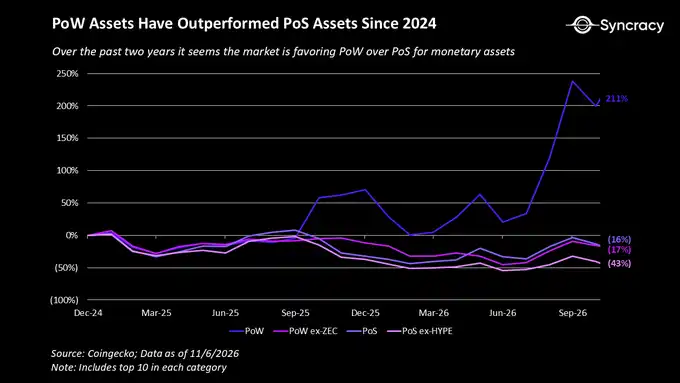
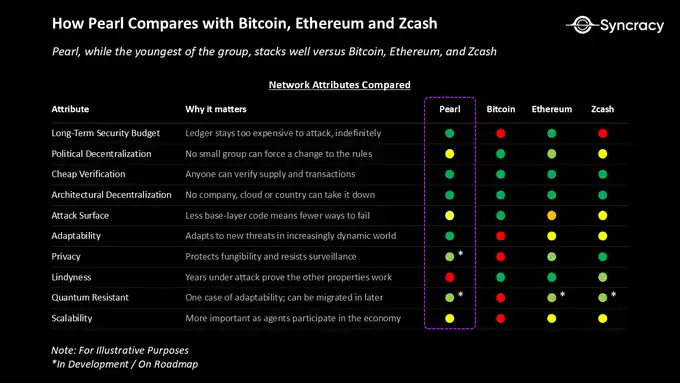
Hardware economics also differ. Bitcoin ASICs are specialized for Bitcoin mining; GPUs used for Pearl can be redeployed. Syncracy acknowledged that this makes Pearl’s hardware commitment less binding and that resource totals alone could overstate the economic cost of attacking its network. Pearl’s need to update its consensus algorithm as AI computing formats change is another trade-off: Syncracy said the network had undergone four forks since April and planned another to support FP8.
For mining operators, the next evidence is operational rather than promotional: the FP8 upgrade’s measured overhead, the share of Pearl mining performed alongside paid inference tasks, and whether providers keep contributing that work when PEARL mining revenue falls. Syncracy’s projections depend on those inputs; they were not established outcomes as of its November 19 report.